
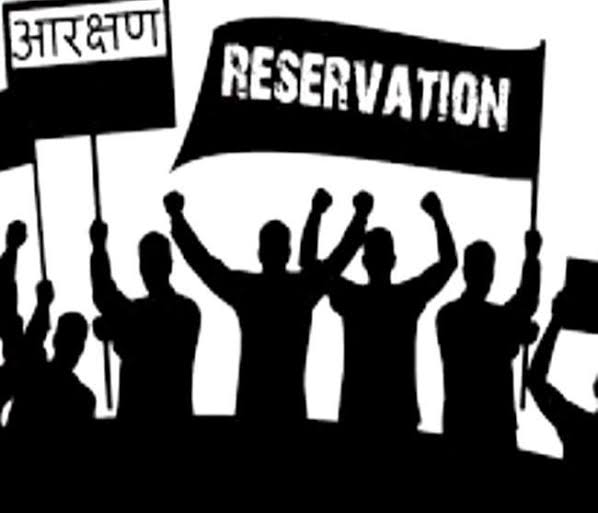
There is a new political movement in town. Ever since the amazing success of the Cockroach Janta Party in organising the student protest that ultimately led to the resignation of Dharmendra Pradhan, the Union Education Minister, a new satirical party by the name of Reservation Hatao Andolan is slowly rising in the ranks. As their name suggests, it’s a movement to remove reservations for backward and scheduled caste people, and people from weaker economic backgrounds in public sector education and jobs.

At a time when political parties from every spectrum are doubling down on the reservation system, this objective is a rather brave one. But rather than focusing on the actual issues, RHA’s priority seems rather misplaced, at least in their present state. The movement is definitely making noise on social media, but everyone is afraid of asking the question that actually matters: Why are millions of young Indians forced to compete over so few opportunities in the first place?
Reservation was never envisioned as a form of charity; instead, it was created to compensate for the unequal starting point. It was established to address centuries of caste-based discrimination, social exclusion, and lack of representation for marginalized groups. It was envisioned as a form of affirmative action where individuals from marginalized groups must be provided with better education and jobs in fields from which they were shut out for generations.
The Constitution of India guarantees reservation for representation and better opportunities, but there are still numerous factors that create a divide between the law and actual reality. Equality on paper doesn’t mean equality in practice. Oppressed communities who have faced discrimination for a long time lack the education, wealth, and network to compete fairly. Not to mention the implicit bias in society itself, where, despite the presence of anti-discriminatory laws, people still face segregation based on abstract rules and arbitrary classifications.
Imagine two students. One living in a well-to-do family in an urban household, other living in a rural household. The urban kid will have an English-medium school, better coaching facilities, better internet infrastructure, and an educated parents at his disposal. While the village kid will face limited educational opportunities, shortage of good teachers, financial pressure, and a severe language barrier. This is where reservation comes to compensate at the end of the race due to unequal starting point, although what India needs is equality at starting line itself.
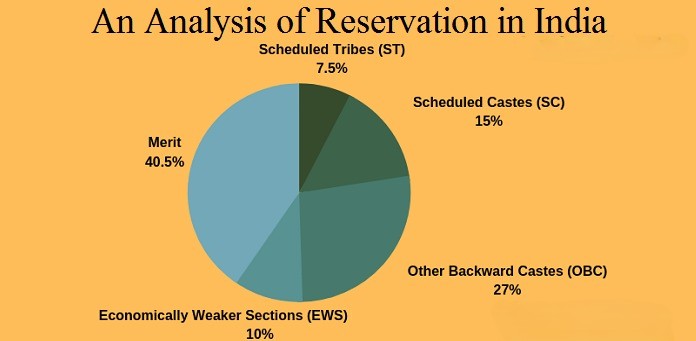
But as they say, the grass isn’t always greener on the other side. So, it’s not like reservation is a perfect system, at least in its present form. There are tons of instances where deserving candidates miss the opportunity due to unequal and sometimes unfair cutoffs. Families who’re no longer disadvantaged and yet continue to receive the benefits is another big issue that needs addressing. Similarly, non-reserved category people, especially from the rural background, also face disadvantage due to poverty and lack of education. These are the chief reasons for the commencement of a movement like RHA.
However, recognizing inequality doesn’t mean that every position should be treated equally. In professions where the competence on an individual is directly proportional to the safety and lives of others, a minimum standard must remain non-negotiable. Medicine is the clearest example of this where a doctor or a surgeon, no matter from which background he belongs to, must possess the knowledge and ability to operate safely. The same can be said about engineers building critical infrastructure, or academicians conducting original research, which adds knowledge to their respective domains. Reservation can create access to these fields by addressing the inequality faced by individuals during their educational period, but at higher levels and in highly specialized roles, the selection should ultimately depend on merit. Social justice should make the path to opportunity equal for everyone, but it should never require the society to lower their standards.

That said, the prime issue isn’t the reservation system; its scarcity. Why are 20 lakh students forced to compete over 20,000 seats? Even if you take the reservation out of this scenario, 99% of the students are bound to be disappointed. Similarly, a single post of government job attracts 1000s of applicants. Reservation isn’t creating this competition; the job shortage is driving this lopsided contest. When the opportunities are limited, the fight over paucity becomes inevitable.
Instead of asking for reservation to stay or go away, we should ask real questions: Why do not we have enough quality public education institutions with enough seats? Why is affordable higher education so scarce? Why aren’t enough jobs being created? And why must millions of people compete for a handful of opportunities every year? This is where the attention of public should be, but sadly they are focusing on totally irrelevant points.

The demand should be of better schools and colleges, more quality universities, better teacher training, more scholarship for students who are in need, greater investment in research, more employment opportunities, and to top it all off, there should be a periodic review of reservation policies to ensure it’s serving the intended group in an effective manner.
The discourse on internet might lead you to believe that reservation is India’s biggest problem; it isn’t. The actual problem is a lack of opportunity. The day when every child starts receiving same quality of education, every young person has access to meaningful employment, and social discrimination no longer shapes the lives of individuals, the reservation may not be necessary. Until then, arguing about reservation is like arguing over a small cracked patch in the wall while ignoring that the roof of the entire house is falling.
 The free voice