Quad nations agreed to strengthen energy security, martime surveillance, and supply chains in the Indo-Pacific amid rising tensions in the Strait of Hormuz
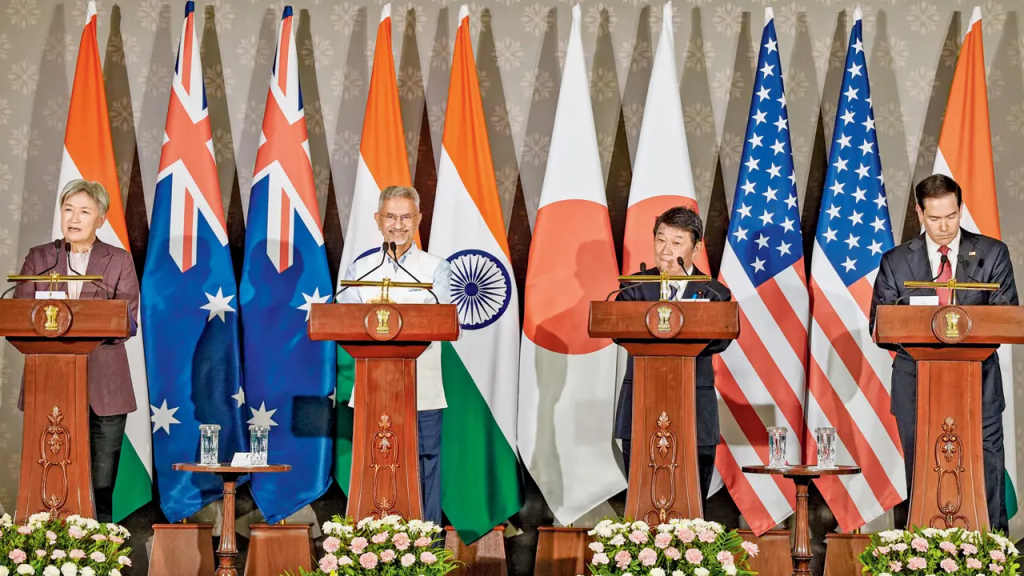
The high-level meeting concluded drawing the participation of Indian External Affairs Minister S. Jaishankar, U.S. Secretary of State Marco Rubio, Japanese Foreign Minister Toshimitsu Motegi, and Australian Foreign Minister Penny Wong. The leaders finalized several far-reaching strategies aimed at stabilizing the regional economy.
Quad Expresses Deep Concern Over the Hormuz Crisis
In a joint statement, the Quad nations voiced profound concern regarding the volatility surrounding the Strait of Hormuz. Recent escalations in Middle East conflicts have triggered a sharp spike in global crude oil prices. This disruption has directly impacted electricity rates, fuel costs, fertilizer pricing, and petrochemical supply networks worldwide.
Japan: Foreign Minister Toshimitsu Motegi noted that the Quad’s role in championing a “Free and Open Indo-Pacific” (FOIP) is consistently expanding.
India: External Affairs Minister S. Jaishankar highlighted that the Indo-Pacific is currently navigating a complex array of economic and maritime challenges.
United States: Secretary of State Marco Rubio assured that the member states would rapidly deploy new initiatives to guarantee fuel and energy security.
Australia: Foreign Minister Penny Wong strongly opposed the imposition of any unilateral tolls or tariffs in the Strait of Hormuz, emphasizing the non-negotiable nature of free maritime transit.
Accelerating Focus on Critical Minerals and Supply Chains
A major highlight of the summit was the launch of the “Quad Critical Minerals Framework.” This initiative is designed to drive mutual investment and technical synergy in the mining, processing, and recycling of essential raw materials.
Parallel to this, India and the United States signed a bilateral agreement to ensure a resilient supply of rare earth elements. Minister Jaishankar stated that the primary objective of this pact is to diversify supply networks, thereby reducing vulnerable dependencies on any single global source.
Zero Tolerance Against Terrorism:
Elevating the security discourse, Minister Jaishankar asserted that there must be zero tolerance toward terrorism, defending the inherent right of targeted nations to secure their borders. He added that long-term stability in the Indo-Pacific relies heavily on unassailable supply chains, protected maritime trade routes, and trusted technological partnerships.
The Three Structural Pillars of the New Quad Consensus
To institutionalize their goals, the Foreign Ministers agreed on three major regional initiatives:
Enhanced Maritime Surveillance: Boosting satellite data-sharing, securing critical undersea internet cables, and collaborating on a new joint port development project in Fiji.
Critical Minerals Framework: Strengthening resource independence through joint technological ventures in processing, mining, and recycling vital minerals.
Energy Security Infrastructure: Launching a dedicated “Fuel Security Forum” alongside joint emergency response drills and formalized energy market information-sharing.
The New Delhi summit serves as a definitive indicator that the Quad is rapidly evolving beyond its traditional maritime security roots. The alliance is swiftly positioning itself as an economic and energy bulwark designed to anchor global supply chains. As geopolitical friction points multiply, experts believe the Quad’s deepening strategic integration will play a decisive role in shaping global politics and market economics in the years ahead
 The free voice