India summons US envoy and demands attacks stop, but faces pressure over its measured tone as Modi prepares to meet Trump at G7
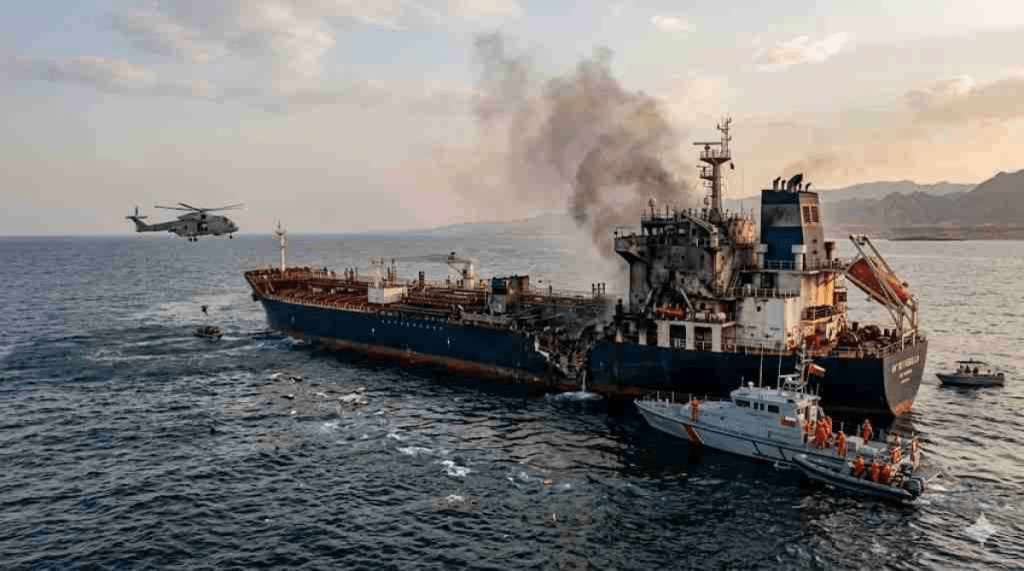
Three Indian seafarers are dead after the US Navy fired precision munitions at a commercial oil tanker in the Gulf of Oman on June 10, triggering outrage across India and forcing the government into a difficult diplomatic balancing act with one of its most important strategic partners.
What happened in the Attack
The US Navy fired precision munitions into the engine room of the Palau-flagged oil tanker MT Settebello as it transited the Sea of Oman carrying Iranian oil, causing a fire and a large rescue operation. Of the 24 Indian crew members aboard, 21 were rescued. Shipping Minister Sarbananda Sonowal confirmed that the three remaining missing sailors were found dead, their bodies located and identified after the strike.
The Settebello attack was not an isolated event. The US military struck three ships carrying Indian seafarers in the Gulf of Oman within a single week: MT Marivex, MT Settebello and MT Jalveer. Marivex was disabled on June 8 with all crew rescued safely. On June 11, Jalveer was struck by US Hellfire missiles after the crew allegedly failed to comply with the American naval blockade on Iran, with all 20 Indian sailors reported safe.
India Protests but Treads Carefully
The Ministry of External Affairs summoned US Chargé d’Affaires Jason Meeks, handed him a formal diplomatic note of protest, and publicly confirmed that all three incidents resulted from US Navy attacks. Foreign ministry spokesperson Randhir Jaiswal stated that the attacks must stop and said India would raise the issue at the G7 summit in France.
Former Ambassador Anil Trigunayat backed the government’s response and said India did the right thing by summoning the US envoy and registering a strong protest, adding that India must continue to firmly convey its strongest concerns whenever its citizens are endangered.
Why India Has Not Gone Further
The deaths come days before Prime Minister Modi is expected to hold a bilateral meeting with President Trump on the sidelines of the G7 summit in Evian-les-Bains from June 15 to 17, a meeting New Delhi has been carefully preparing for. The US military and the Trump administration have not offered any word of regret over the killings and have continued targeting commercial ships with Indian sailors on board despite New Delhi’s protests.
Washington’s recent posture toward India has shifted between praise for Modi and sharp criticism over trade policies and Indian purchases of Russian oil, leading sections of India’s strategic community to worry that Washington increasingly views New Delhi as a target of pressure rather than a genuine partner. Against that backdrop, India is trying to protect its citizens and its relationship with the United States at the same time, and the two goals are proving increasingly difficult to pursue together.
 The free voice