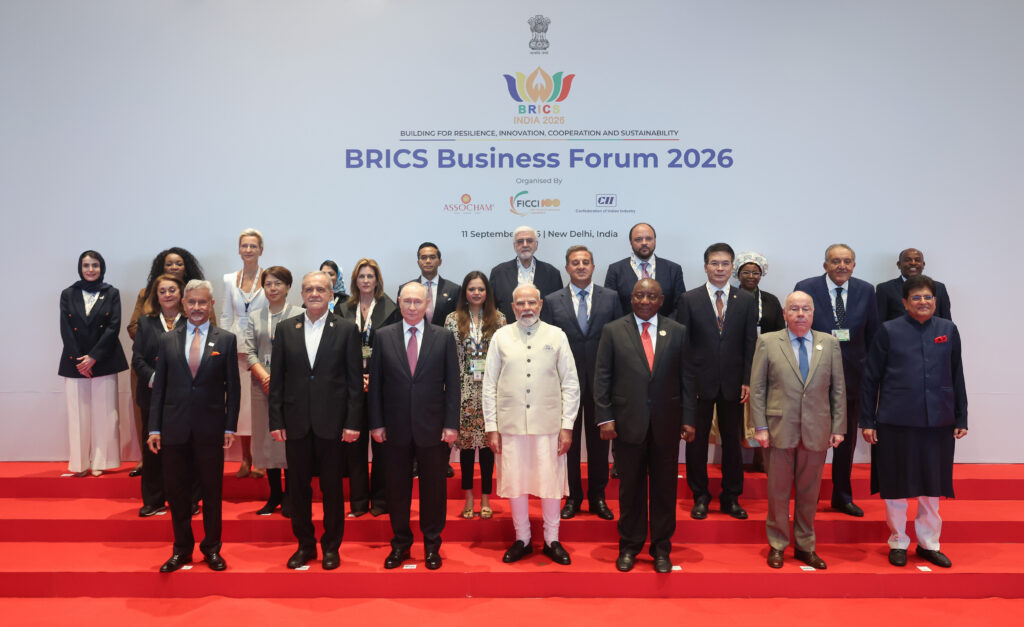
The 18th BRICS Summit in New Delhi ended on September 13 with an important message: the emerging economies want a bigger voice in how the world is run.
But the summit was also a test of how united BRICS really is.
The 11-member group includes countries with very different political interests, including India, China, Russia, Iran, the UAE and Saudi Arabia. Despite these differences, the leaders managed to agree on a New Delhi Declaration covering trade, terrorism, global conflicts, artificial intelligence, climate change, health and reform of international institutions.
For India, which hosted the summit under its 2026 BRICS chairship, the meeting was also an opportunity to push its own priorities and strengthen its position as a voice of the Global South.
1. BRICS wants a bigger voice in global affairs
One of the biggest themes of the summit was that developing and emerging economies should have a greater say in global decision-making.
BRICS countries called for reforms in institutions such as the United Nations, IMF and World Bank, arguing that these organisations should better reflect today’s economic and political realities.
For India, this is a familiar demand. New Delhi has repeatedly argued that developing countries cannot remain under-represented in institutions that make decisions affecting the entire world.
The New Delhi Declaration again called for greater representation of emerging and developing economies in global governance.
2. India puts terrorism firmly on the agenda
Terrorism was another important issue for India.
The New Delhi Declaration strongly condemned terrorism and included a reference to the Pahalgam terror attack, a point that is particularly significant for New Delhi.
India has consistently pushed BRICS to take a stronger position against terrorism, including terrorist financing and safe havens.
The summit therefore gave India an opportunity to ensure that terrorism remained a central part of the group’s security discussions.
3. No BRICS currency yet
For years, there has been speculation about BRICS creating its own currency to challenge the US dollar.
But the 2026 summit did not produce such a move.
Instead, BRICS countries focused on something more practical: making it easier for members to conduct trade and investment using their local currencies.
The group also continued work on making payment systems more compatible across countries.
So, rather than creating a new BRICS currency overnight, the bloc appears to be taking a gradual approach to reducing dependence on traditional international payment systems.
4. AI becomes a major BRICS priority
Artificial intelligence was another major focus.
BRICS countries recognised that AI could transform economies, healthcare, agriculture, education and industries. But they also stressed that developing countries should not be left behind in the AI race.
The declaration supported greater cooperation in science, technology and innovation, including sharing knowledge and building technology capabilities.
This is particularly important for India.
India has been pushing its digital public infrastructure and technology model as something that can be shared with other developing countries.
The summit also backed initiatives around digital infrastructure, industrial skills and technology cooperation.
5. India-China ties get an important push
The summit also became an important moment for India-China relations.
Prime Minister Narendra Modi met Chinese President Xi Jinping on the sidelines of the summit. The two sides discussed improving bilateral relations, business links, connectivity and resolving outstanding issues along the border.
Xi’s visit was significant because it was his first trip to India in seven years.
The relationship remains complicated, particularly because of the unresolved border issue and India’s large trade deficit with China. But the latest meetings indicate that both sides are interested in stabilising ties and expanding economic engagement.
For Indian businesses, any improvement in India-China relations could have implications for trade, supply chains and access to Chinese products and components.
6. The West Asia war tested BRICS unity
Perhaps the biggest challenge for BRICS was the ongoing conflict in West Asia.
The group includes countries with very different positions and relationships in the region.
That made it difficult to agree on a strong common position.
According to Al Jazeera, the bloc stopped short of directly condemning the US-Israel war on Iran, highlighting the differences between its members.
However, the countries did manage to agree on a broader call for de-escalation and peaceful solutions.
That itself was significant.
It showed that BRICS can still find common ground, even when its members disagree on major geopolitical issues.
7. Trade and tariffs remain a big concern
Global trade tensions were another major issue.
BRICS criticised unilateral tariffs and protectionist trade measures that it said could disrupt global commerce.
This matters for India because the country’s economy is deeply connected to global supply chains.
Higher tariffs or restrictions can increase the cost of importing raw materials and components, while also making it harder for Indian companies to export their products.
The BRICS declaration therefore stressed the need for more reliable and resilient global supply chains and greater participation of developing countries in higher-value manufacturing.
8. Agriculture gets a technology push
Agriculture was another area where India tried to make BRICS cooperation more practical.
The summit backed initiatives focused on climate-resilient and sustainable agriculture, including agroecology, regenerative farming and digital agriculture.
For India, this could be particularly useful.
Technology such as satellite data, artificial intelligence and digital platforms can help farmers with weather information, crop monitoring, irrigation and productivity.
The larger goal is to make agriculture more resilient while dealing with climate change and food-security challenges.
9. Health and disease preparedness
The summit also focused on global health.
India proposed stronger cooperation and an early-warning approach for infectious diseases.
This is important after the lessons learned from the COVID-19 pandemic.
The idea is simple: countries should be able to share information and respond faster when a new health threat emerges.
BRICS also discussed cooperation in areas such as healthcare, medical research and access to essential technologies.
10. What did India gain from the summit?
For India, the summit was not just about issuing a joint declaration.
It was an opportunity to showcase New Delhi as a major player in the Global South.
India pushed issues such as:
- Terrorism and counter-terror cooperation
- Greater representation for developing countries
- Digital public infrastructure
- AI and technology
- Local-currency trade
- Agriculture and food security
- Health cooperation
- Climate resilience
- Support for MSMEs and startups
India also proposed a BRICS Risk Lab at GIFT City in Gujarat, aimed at improving cooperation on financial risks and resilience.
Is BRICS really becoming a rival to the West?
This is probably the biggest question after the summit.
BRICS has grown significantly since it was created. It now includes 11 members, representing a huge share of the world’s population and economy.
But the group is not a traditional alliance.
India has very different interests from China. Russia has its own geopolitical priorities. Gulf countries have their own relationships with the US and Europe. Iran has a very different position from many other members.
That makes it difficult for BRICS to act as one united bloc on every international issue.
The West Asia conflict was a good example of this problem.
Experts therefore argue that BRICS does not necessarily need to replace Western institutions to become more influential. It can increase its influence simply by giving developing countries more alternatives and a stronger collective voice.
The biggest takeaway for India
The 2026 BRICS summit showed both the strength and limitations of the grouping.
On one side, BRICS is becoming bigger and more influential. It is discussing trade, technology, AI, finance, health, agriculture and global governance.
On the other, its members do not always agree on major geopolitical questions.
For India, that balancing act is important.
New Delhi wants stronger ties with the US and other Western economies, while also maintaining strategic relationships with Russia, China and the wider Global South.
BRICS gives India another platform to pursue that multi-aligned foreign policy.
The real test, however, will come after the cameras leave New Delhi.
If the promises on trade, technology, payments, health and development turn into actual projects, BRICS could become much more important in the years ahead.
India has now handed the BRICS chairmanship to China for 2027. The next question is whether the expanded group can turn its growing influence into concrete results.
 The free voice