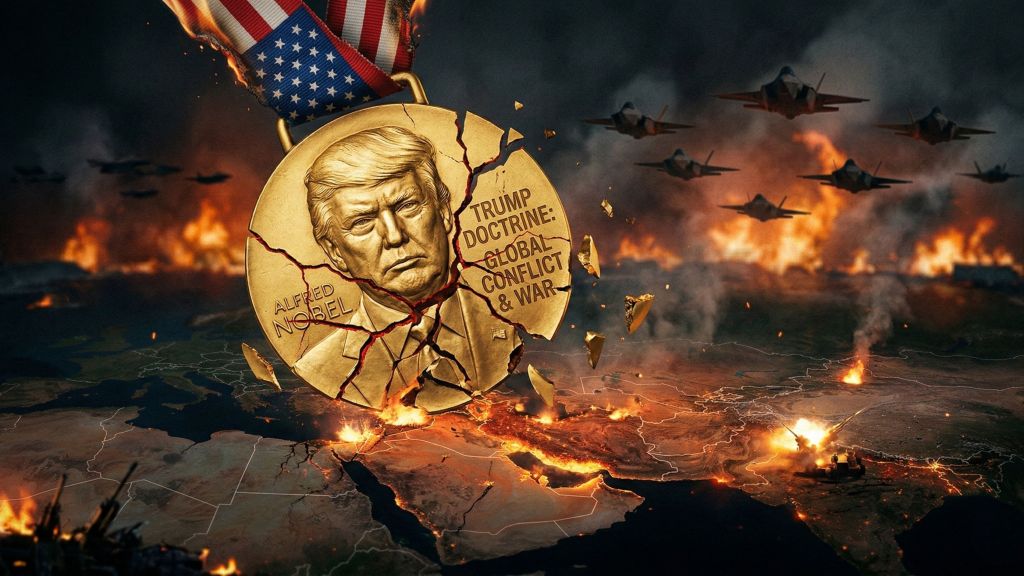
History is a witness that whenever a superpower resorts to war to salvage its waning prestige, both the geography and the destiny of the world undergo a radical transformation. The United States, which emerged from the wreckage of World War II as the self-appointed guardian of the global order, today finds itself at the dark center of international controversy.
“The price of greatness is responsibility.” — Winston Churchill
But is the America of today living up to that responsibility? Or is it, under the leadership of President Donald Trump, dismantling the very ‘Global Order’ it once meticulously constructed?
The rise of a superpower and the fear of decline
Following World War II, America ascended as a peerless global titan. For the next five decades, the Cold War with the Soviet Union bisected the world into two poles, but with the 1992 dissolution of the USSR, America became the world’s “sole superpower.” To maintain its hegemony in Asia, Washington often established surrogate governments, gaining indirect control over vital oil and mineral resources. Today, however, in the era of Donald Trump, it appears that the U.S. is willing to go to any lengths to reclaim its lost influence—even if it means earning a metaphorical “Nobel Prize for Conflict and War.”
From the deaths of millions of innocents in Syria, Iraq, Lebanon, and Jordan to the humiliating withdrawal from Afghanistan after decades of trillion-dollar spending, Washington’s dominance has been replaced by a massive question mark.
The Gaza crisis and the rhetoric of double standards
The U.S. role in the ongoing Israeli offensive in Gaza remains its most contentious diplomatic failure. In a conflict that has raged for over three years, more than 7 million people have been displaced, and over 30,000 innocent children have lost their lives. Despite this, the continuous supply of American weaponry and the repeated use of the Veto power in the United Nations have shredded Washington’s “humanitarian” mask.
It is a profound irony that the UN, established in 1945 to maintain global equilibrium, now watches as its five Veto-wielding members remain locked in their own power struggles. Even the Prime Minister of Canada recently acknowledged a sobering reality: the United States is no longer the undisputed superpower it once was.
Strike on Iran: Strategic control or total catastrophe?
The surging influence of China in Asia has undeniably rattled Washington. This raises a critical question: can the assassination of Iran’s Supreme Leader truly restore American control over the Middle East?
- The Trump Doctrine: The “America First” policy prioritizes U.S. interests at any cost. A strike on Iran is viewed by many as a move to tighten the grip on Middle Eastern oil reserves under the guise of national security.
- The Balance of Power: Most geopolitical experts argue that targeting Iran’s top leadership will not restore American prestige. Instead, it risks engulfing the entire Middle East in the flames of an endless, catastrophic war.
The destruction of the global order
America appears ready to push the world to the brink to regain its former strength. But is the hegemony of a single nation worth the sacrifice of global peace? By disregarding international law and the sovereignty of other nations, Washington is not fixing the global order—it is burning it down.
The elimination of Iran’s Supreme Leader might end the life of one individual, but the resulting hatred and instability will never bring back the “Old Glory” that America so desperately seeks.
The struggle for power and the collapse of global governance
Modern global politics stands at a crossroads where peace is confined to paper and the raw display of power has become the new “law.” The United States, which once built its global reach under the umbrella of Churchill’s “Great Responsibility,” is now searching for its lost credibility in the fires of “America First.” Haunted by the emerging alliance between China and Russia, Washington is reacting with desperation. The moral foundation of the U.S. has been hollowed out by a decade of failures from the ruins of Syria to the vacuum of Afghanistan, and now the indiscriminate support for the slaughter in Gaza.
The bitter truth, echoed by world leaders, is that the custodians of the Veto have become the greatest predators of global sovereignty. In this climate, a strategy to gain control through “decapitation strikes” in Iran is not just a strategic blunder; it is an invitation to a new, more violent era. Such actions mark the end of diplomacy and the definitive beginning of global systemic collapse.
 The free voice