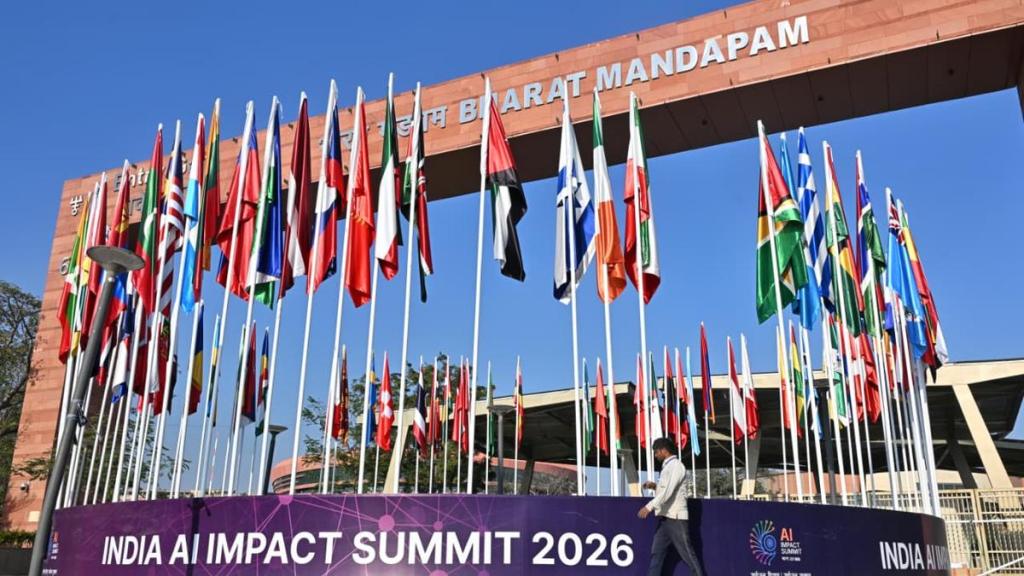
India has taken centre stage in the global artificial intelligence debate this week by hosting the India AI Impact Summit 2026, a five-day international event positioned as the first major AI summit held in the Global South. Organised under the IndiaAI Mission by the Government of India through the Ministry of Electronics and Information Technology (MeitY), the summit is being held from February 16 to 20, 2026, at Bharat Mandapam in New Delhi.
Prime Minister Narendra Modi inaugurated the summit, describing it as proof of India’s rapid progress in science and technology and a reflection of the capability of the country’s youth.
A Summit Built Around Scale and Global Presence
The Indian government has projected the summit as its biggest AI gathering yet, with an expected 250,000 visitors. Participation includes delegations from more than 100 countries, alongside 15 or more heads of state, 45 ministerial level delegations, and over 100 chief executives from major global companies.
Prominent attendees and expected participants include Sam Altman of OpenAI, Sundar Pichai of Google, Dario Amodei of Anthropic, Brad Smith of Microsoft, Cristiano Amon of Qualcomm, and Yann LeCun of AMI Labs. Global leaders expected to attend include French President Emmanuel Macron and Brazilian President Luiz Inacio Lula da Silva.
Theme Focused on People, Planet, and Progress
The summit’s theme, “Shaping AI for Humanity, Inclusive Growth and a Sustainable Future,” is anchored in the guiding principles of People, Planet, and Progress, described by organisers as the summit’s three sutras.
Discussions are centred on human centric and responsible AI, sustainable innovation, AI for economic growth, governance and policy coordination, and the foundational infrastructure required to scale AI such as compute and data. A major focus is also being placed on real world applications in healthcare, public services, and jobs, as well as urgent issues such as job disruption and child safety.
India is using the summit to position itself as a bridge between advanced economies and the Global South, pointing to its digital public infrastructure, including digital identity and payment platforms, as a model for deploying AI at scale while keeping costs low.
Expo, Global Challenges, and Major Announcements
The summit includes the AI Impact Expo 2026, featuring 300 or more exhibitors, 10 thematic pavilions, and 600 startups, supported by 500 sessions and 3,000 speakers. Side initiatives include YUVAI, the AI for ALL Global Impact Challenge, and AI by HER, aimed at expanding AI access and innovation for social good.
A key announcement came from Google, which launched a 30 million dollar Google.org AI for Science Impact Challenge to support global researchers using AI for scientific breakthroughs.
Early Logistical Criticism, Summit Continues
Despite its ambitious scale, the summit faced criticism on its opening day. Attendees reported long queues, overcrowding, poor signage, limited seating, and confusion after sudden security sweeps. Startup founder Maitreya Wagh of AI voice company Bolna posted that he could not access his booth due to closed gates.
The summit also saw a minor controversy after an Indian university was reportedly asked to vacate its stall for misrepresenting a commercially available Chinese robotic dog as its own innovation.
The summit is expected to conclude with a nonbinding New Delhi Declaration, outlining a shared roadmap for global AI governance and collaboration, signalling a broader shift toward actionable and development focused AI policy worldwide.
Sale at: https://amzn.to/405SIPN
 The free voice