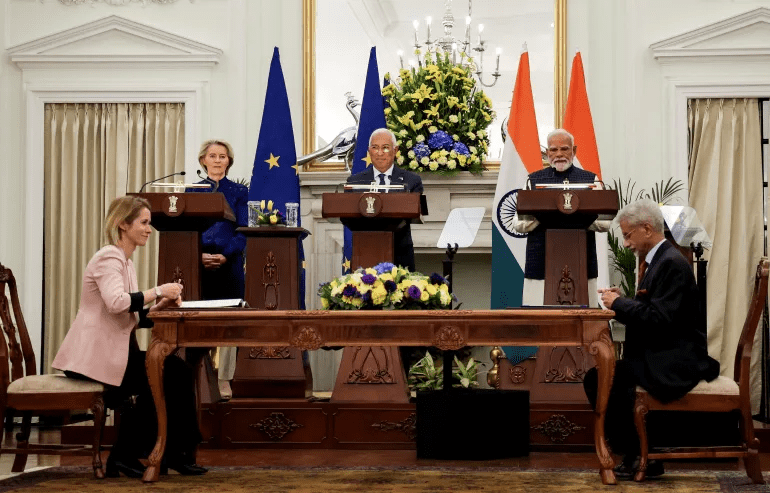
India’s recent strategic maneuver on the global geopolitical stage has sent ripples through the international community, fundamentally redefining the architecture of global trade. After nearly two decades of complex negotiations, the nation and the 27-member European Union (EU) have finally ratified a historic Free Trade Agreement (FTA). This landmark pact is far more than a mere commercial exchange; it represents a decisive response to entities attempting to stifle India’s economic momentum through aggressive tariffs and trade barriers. Encompassing a staggering population of 2 billion and a combined market value of approximately $27 trillion, this agreement serves as the ultimate catalyst in India’s journey toward becoming a developed superpower.
The India-Europe FTA: why analysts call it the ‘mother of all deals’
Global analysts are hailing this pact as the ‘Mother of All Deals’ because it bridges the world’s most populous democracy with the world’s largest integrated trading bloc. This partnership is unprecedented, as it eliminates import duties on over 90% of Indian goods, instantly making “Made in India” products more competitive across the European continent. This strategic alignment is particularly significant given the current climate where the United States has imposed steep 50% tariffs on Indian exports. The decision to bypass obstacles created by the U.S. administration—which stalled negotiations over geopolitical disagreements—asserts India’s strategic autonomy and its refusal to let its economic destiny be dictated by any single superpower.
Bilateral exchange: mapping the new import-export highway
The ratification of this agreement paves the way for a dynamic and multifaceted exchange of goods and services between these two economic giants.
- India’s export surge: The domestic market is set to flood Europe with high-quality textiles, engineering goods, gems and jewelry, leather products, and world-leading IT services.
- Advanced European imports: Reciprocal benefits include seamless access to cutting-edge European technology, pharmaceutical innovations, advanced chemicals, and premium dairy technology.
Sectoral impact: identifying the primary economic winners
Specific pillars of the Indian economy are poised for an era of explosive growth under this new trade regime.
- Engineering and manufacturing: Duty-free access will likely push Indian engineering exports toward a $25 billion valuation.
- IT and professional services: Simplified labor mobility will make it significantly easier for Indian tech professionals to operate within Europe, supercharging the service sector.
- Textiles and apparel: The removal of trade barriers provides Indian manufacturers a decisive competitive advantage over traditional rivals like Bangladesh and Vietnam.
Socio-economic benefits: empowering the common man
Tangible prosperity for the average Indian citizen is the ultimate goal behind this high-level diplomacy. This agreement is expected to be a massive engine for job creation, particularly in labor-intensive industries like handicrafts and agriculture. Lower costs for European technology will reduce manufacturing expenses for electronics and machinery within India, leading to more affordable prices for consumers. Furthermore, direct access to a premium European market for tea, coffee, and spices will uplift the rural economy and increase household purchasing power.
Shifting geopolitics: a new balance of power in the West
Global power dynamics are shifting as this agreement provides India with a formidable third pillar in Europe, reducing its singular dependence on Russia or the United States. India has successfully navigated the “double standards” of Western politics—where external powers criticized India’s energy ties while simultaneously purchasing Russian nuclear fuel. This deal sends a clear message: the nation will not bow to external pressure and is fully capable of charting its own independent economic course on the world stage.
India’s global economic footprint: a comparative analysis
| Region/Country | Population (Approx.) | Market Value (GDP) | Primary Economic Advantage |
| India | 1.45 Billion | $4 Trillion | Massive export potential & young workforce |
| European Union | 450 Million | $23 Trillion | Hub for high-tech innovation & investment |
| Combined Power | ~2 Billion | ~$27 Trillion | 25% of the Global GDP |
The road to prosperity: India’s expanding FTA portfolio
The victory with the EU stands as the crowning achievement in a series of aggressive trade diplomacies pursued in recent years. This proactive approach has already resulted in successful agreements with the UAE (2022), Australia (2022), and the EFTA nations (2025). With upcoming deals with the UK and Oman, India is steadily weaving a global web of economic partnerships that will serve as the bedrock for the “Developed India 2047” vision.
 The free voice