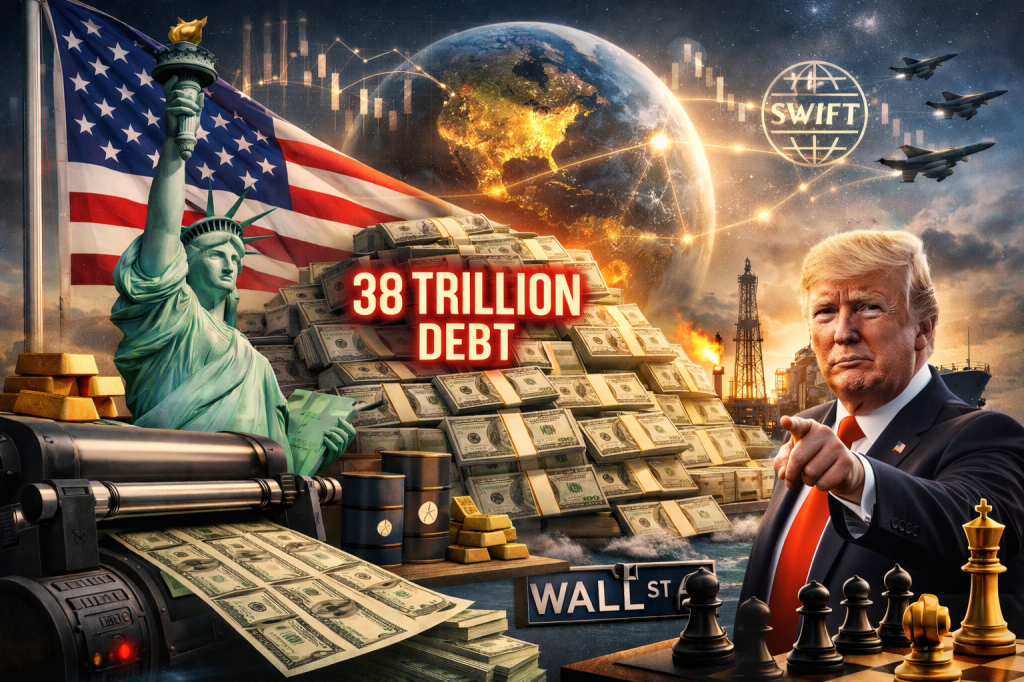
When a country runs a fiscal deficit, it usually has only two options to bridge the gap: sell assets or borrow money. In most cases, persistent deficits weaken an economy. Yet the United States insists that its massive fiscal imbalance poses no real threat.
Today’s global economy rests on a striking paradox. The United States currently carries an enormous debt burden of nearly $38.3 trillion, a figure steadily moving toward twice its GDP. Every year, Washington adds roughly $1.8 trillion to its fiscal deficit—meaning the country spends far more than it earns. On top of that, the U.S. pays close to $1 trillion annually just in interest on its debt.
Despite these alarming numbers, the American economy has not collapsed, nor has the credibility of the dollar eroded. This raises a critical question: What is the hidden force behind this “mountain of debt” that still allows the U.S. to remain the world’s economic captain?
The secret behind staying on top despite massive debt
The foundation of America’s financial resilience lies in a unique advantage economists call “Exorbitant Privilege.” Unlike other countries, which must earn foreign currency to repay external debt, the United States borrows entirely in its own currency—the U.S. dollar.
In simple terms, the U.S. does not need to struggle to acquire dollars to service its debt; it can technically print them. Central banks and global investors continue to park their wealth in U.S. Treasury bonds, viewing them as the safest assets in the world. As long as global capital trusts America as a safe haven, the risk of U.S. bankruptcy remains virtually nonexistent. This creates a powerful cycle in which global money continually reinforces American dominance.
The real power of the U.S.: dollar supremacy
America’s true strength lies not in its nuclear arsenal, but in its currency. Nearly 60% of global foreign exchange reserves are held in dollars, and over 90% of international trade transactions involve the greenback.
The dollar is no longer just a currency—it is the oxygen of global commerce. Every country needs dollars to trade internationally, ensuring constant demand. According to reports by The Wall Street Journal, until a credible alternative such as the euro or a digital yuan gains universal acceptance, the dollar’s dominance will remain intact. This persistent demand allows the U.S. to inject new liquidity into its economy without fear of immediate consequences.
Oil, power, and the petrodollar cycle
In the 1970s, the United States cemented dollar supremacy through the petrodollar system. Agreements with Saudi Arabia and OPEC ensured that oil would be sold exclusively in dollars. Since every nation requires energy imports, countries are forced to acquire dollars to purchase oil.
This arrangement transformed the dollar into the world’s only mandatory currency. Every barrel of oil sold reinforces dollar demand, relieving pressure on the U.S. debt burden. Beyond pricing oil, America has also maintained influence over major shipping routes and energy storage hubs that control the flow of global supply.
Control of sea routes: the silent pillar of power
Nearly 80% of global trade moves by sea, and U.S. dominance over strategic maritime chokepoints—such as the Strait of Hormuz, the Suez Canal, and the Strait of Malacca—forms a critical pillar of its global authority.
The U.S. Navy remains the only force capable of blocking or securing any major sea route at will. This control serves two strategic purposes: it guarantees trade security for allies aligned with U.S. policies, and it gives Washington the ability to cripple adversaries by threatening their energy supply lines—without firing a single shot. As a result, global trade continues to function confidently in dollars, under American protection.
Sanctions: America’s invisible army
Economic sanctions have become one of America’s most effective weapons. When the U.S. targets a country financially, that nation can be cut off from the global economy almost overnight.
This power stems from America’s control over the international financial system rather than from military might. As Forbes notes, sanctions operate like an “invisible army.” Because most global banks are linked to U.S.-centric financial networks, Washington can freeze dollar transactions at the push of a button. This is precisely how countries such as Russia, Iran, and North Korea have been economically constrained.
SWIFT: the gatekeeper of global transactions
A key technical pillar of dollar dominance is the SWIFT system. Though headquartered in Belgium, the network operates largely under U.S. influence.
Almost every cross-border bank transfer relies on SWIFT. If a country is removed from the system, it effectively becomes blind and paralyzed in international trade. SWIFT functions as the remote control of global money flows—one that allows the U.S. to monitor and regulate worldwide financial transactions.
Donald Trump’s tariff strategy and the road ahead
In 2026, Donald Trump’s renewed tariff agenda is widely seen as an attempt to protect dollar dominance. By imposing heavy taxes on foreign goods, the strategy aims to reduce the U.S. trade deficit while limiting dollar outflows abroad—thereby strengthening the currency’s value.
Trump has also pushed to position America as the world’s largest exporter of oil and gas. If the U.S. becomes a dominant energy supplier while reducing imports, it would gain even greater control over global dollar circulation. According to Bloomberg, this “America First” doctrine may pose challenges for other nations, but it acts as a financial shield for preserving dollar supremacy.
 The free voice