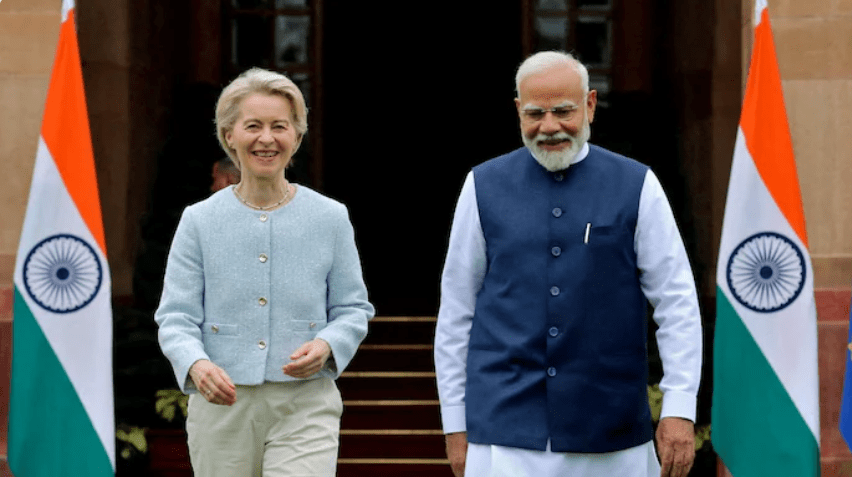
The European Union and India have agreed on an ambitious free trade agreement that will significantly expand market access, cut tariffs across most traded goods, and deepen cooperation in services, digital trade, sustainability and regulation, marking a major reset in bilateral economic ties.
Bilateral trade in goods between the EU and India stood at €120 billion in 2024. EU imports from India reached €71 billion, while exports to India totalled nearly €49 billion. Once implemented, the agreement will liberalise 99.3 per cent of EU trade and 96.6 per cent of Indian trade, making it one of the most comprehensive trade deals either side has signed.
Tariff Cuts to Open Key Sectors on Both Sides
Under the agreement, the EU will eliminate tariffs on over 90 per cent of tariff lines, while India will remove duties on 86 per cent of tariff lines, with further partial liberalisation covering most remaining products.
For the EU, the biggest gains will come in agri-food, chemicals, pharmaceuticals, machinery, medical devices, avionics and automotive products. India will benefit from improved access for fisheries, textiles, footwear, chemicals and pharmaceuticals.
India has agreed to phase out high industrial tariffs, many of which currently average above 16 per cent. Duties on chemicals and textiles will largely be removed at the entry into force of the agreement, while tariffs on cosmetics, plastics, car parts and machinery will be eliminated gradually over five to ten years. These changes are expected to unlock EU exports that were previously uncompetitive in the Indian market.
In agriculture, the deal strikes a careful balance. India will reduce or eliminate duties on products such as olive oil, processed foods, fruit juices and sheep meat. Tariffs on wines, spirits and beer, which can reach as high as 150 per cent, will be lowered over time. At the same time, the EU has protected sensitive sectors such as sugar, rice, beef, poultry and dairy products, while maintaining strict food safety and animal health standards.
Beyond Goods: Services, Digital Trade and Standards
Services trade between the two sides amounted to nearly €60 billion in 2024. The agreement improves market access for service providers, strengthens rules on financial services, and includes commitments on professional mobility. It also introduces clearer and more enforceable rules than those currently in place under the WTO framework.
The digital trade chapter establishes protections for software source code, strengthens online consumer rights and limits spam, while allowing both sides to regulate for privacy and security. New rules on customs, trade facilitation, technical standards and sanitary measures aim to reduce red tape and improve predictability for businesses.
Sustainability, SMEs and Governance
The agreement includes binding commitments on labour rights, environmental protection, climate action and gender equality. A dedicated chapter supports small and medium-sized enterprises by improving access to information and simplifying procedures.
With enforceable dispute settlement mechanisms and strong institutional oversight, the EU–India FTA is designed to provide long-term certainty for businesses and investors, while anchoring trade growth in sustainability and rule-based cooperation.
 The free voice