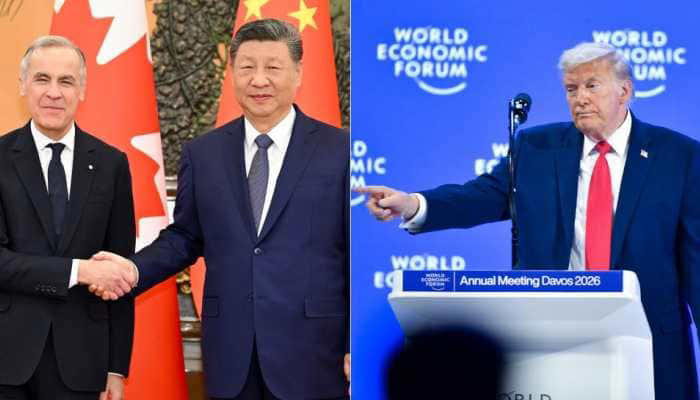
President Donald Trump has escalated trade tensions with Canada, warning that all Canadian exports to the United States could face a 100 per cent tariff if Ottawa proceeds with a newly announced trade arrangement with China. The threat, issued on January 24 through Trump’s Truth Social platform, has raised fears of a fresh trade war between two of the world’s closest economic partners.
The warning represents a sudden reversal. Just days earlier, Trump had publicly suggested that Canada was free to pursue trade agreements that suited its interests. The shift has added to concerns among investors and policymakers about the unpredictability of US trade policy under Trump’s second term.
Canada’s China Move Triggers Washington Alarm
The dispute centres on a preliminary Canada-China trade understanding unveiled this month by Prime Minister Mark Carney. The deal would lower Chinese tariffs on Canadian canola exports while allowing a limited number of Chinese electric vehicles into the Canadian market at reduced duties. Ottawa has framed the move as a necessary step to diversify trade as US protectionism intensifies.
Washington sees it differently. US officials fear the agreement could allow Chinese products to reach the American market indirectly through North America, undercutting US tariffs that are aimed at curbing China’s dominance in strategic industries such as electric vehicles and clean technology.
Trump echoed those concerns bluntly, accusing Canada of acting as a conduit for Chinese goods and warning that Beijing would economically overwhelm the country.
Ottawa Pushes Back on Sovereignty
Canadian leaders have responded defiantly. Carney has insisted that Canada will not allow its trade policy to be dictated by Washington, arguing that reliance on a single partner is no longer sustainable.
“The choice is ours,” Carney said, signalling that Ottawa intends to pursue an independent economic path despite the risks. His position reflects political sentiment at home, where Trump remains unpopular and economic nationalism in the US is widely viewed as a threat to Canadian stability.
High Economic Costs on Both Sides
The stakes are enormous. The United States absorbs roughly 75 per cent of Canadian exports, with annual bilateral trade exceeding $900 billion. Economists warn that a 100 per cent tariff would cripple key Canadian sectors, including autos, energy, agriculture and manufacturing.
Studies suggest Canada’s GDP could contract by up to 3 per cent if such tariffs were imposed, triggering job losses and higher inflation. The impact would not be limited to Canada. US consumers would likely face higher prices and supply chain disruptions, particularly in the automotive and construction sectors.
Impact of Trump’s Tarrif Strategy
The threat fits a broader pattern in Trump’s approach to trade, using tariffs as leverage even against allies. Similar tactics have been deployed against Mexico, the European Union and NATO partners over a range of disputes.
Whether the confrontation leads to negotiation or escalation remains uncertain. What is increasingly clear is that the assumption of stable, rules-based North American trade is under strain, with long-term consequences for the region’s economic future.
 The free voice