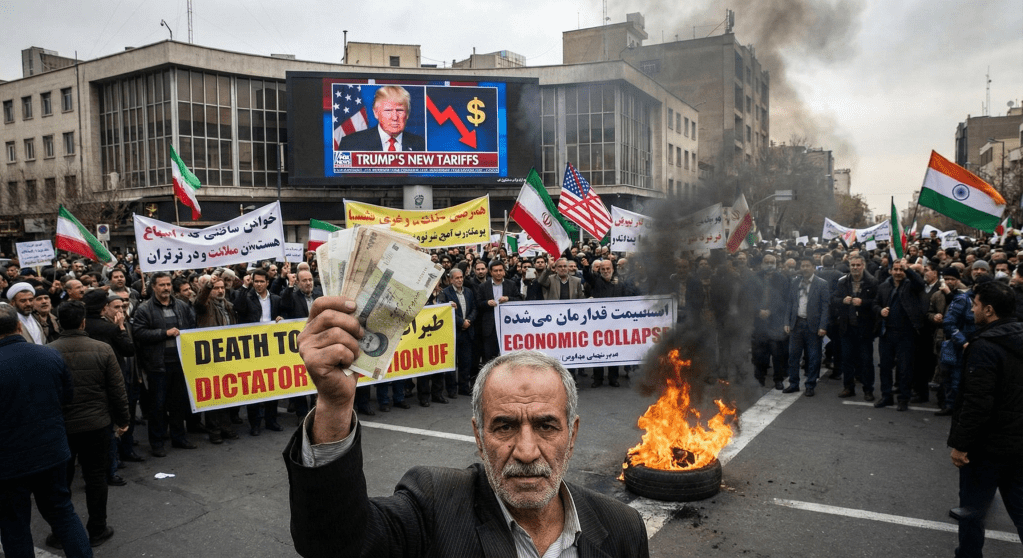
The world is watching with bated breath as Iran has been engulfed in flames for the past 17 days. This turmoil, raging from Tehran to remote areas of the country, is no longer just a normal protest; it has taken the form of a horrific bloody conflict and a potential civil war. While on one hand, people’s anger against Supreme Leader Ayatollah Ali Khamenei’s rule is at its peak, on the other, the backbone of the Iranian economy has completely broken. The death of over 2,000 people, the screams of more than 4,000 injured, and the over 10,000 demonstrators stuffed into jails in the violence continuing for the past two weeks testify that Iran now stands on the threshold of historic change. However, behind this anarchy, the biggest question arising is: Is America’s ‘Maximum Pressure’ policy and Donald Trump’s diplomacy behind this destruction and bloodshed in Iran?
The do-or-die battle against Khamenei and blood-stained street
“Tehran’s streets have transformed into a battlefield as the unrest shifts from civil disobedience to open conflict.” According to human rights organizations and local reports, repression by security forces has made the situation explosive. Millions on the streets are no longer just chanting slogans; their direct target is the Islamic Republic’s Supreme Leader, Ali Khamenei. Protesters, regardless of their lives, are demanding “Death to the Dictator” and “We want freedom,” showing that the public’s fear has now ended. The government has jailed over 10,000 people to crush this rebellion, but instead of stopping, the violence is flaring up further. This struggle has become a do-or-die battle between the regime and the public.
Trump’s ‘truth’ and America’s regime change agenda
Recent statements and decisions by US President Donald Trump have acted as fuel to this fire in Iran, deepening suspicions that America wants regime change there. Through a post on his social media platform ‘Truth Social,’ Trump has given a clear warning to the global community that America will impose an additional 25% tariff on any country that continues trade with Iran. Political analysts believe America’s intention is to bring the radical Islamic regime in Iran to its economic knees and establish a government there that is softer towards Western countries. Bypassing diplomatic norms, Trump has directly addressed Iranian citizens and instigated them for a ‘battle for freedom.’
Zero currency and a collapsing economy
Amidst this political turmoil on the streets, the economic blockade of Iran has made the lives of ordinary citizens completely hellish. The condition of the Iranian currency, the ‘Rial,’ has reached its worst level in history and has crossed ‘zero’ against the dollar. This directly means that the Iranian currency now holds no real value in the international market. The economic structure in the country has crumbled to such an extent that people have to carry sacks full of notes to buy a single dollar. This economic collapse has broken the back of Iran’s middle and poor classes, and this economic helplessness is now pouring out onto the streets as fierce anger against the government.
Why is Iran boiling? The hit of inflation and the call for freedom
Beyond the political chaos lies a financial catastrophe: a crushing economic blockade that has completely dismantled the lives of the common people.” Hyperinflation has reduced people’s savings to ashes; food, medicines, and daily needs are completely out of the common man’s reach. Fed up with hunger and poverty, people have now accepted that the current system cannot extinguish the fire in their bellies. But the anger is not limited to inflation alone; its roots are also deeply embedded in decades of social repression. The fear of the ‘Morality Police’ and strict restrictions on the freedom of women and youth have suffocated the people. Furthermore, the public is angry that the country’s money is being wasted on fighting proxy wars abroad and in corruption instead of on public welfare. The hit of inflation and the desire for freedom combined have turned this protest into a powder keg.
Diplomatic dilemma for India and threat of tariff war
This new economic decree by Trump has emerged as a major diplomatic and trade challenge for India. India and Iran have traditionally had deep trade relations, especially in tea and rice exports. Looking at the data, in the fiscal year 2025-26, India exported approximately 6 lakh tonnes of rice worth $468.10 million to Iran, which is a large market for Indian farmers and exporters. Now India faces a challenge: on one side to save its old relationships and trade with Iran, and on the other, the threat of America’s 25% extra tariff hovers. If India continues trade with Iran, Indian goods will become expensive in the American market, and if it steps back, it will have to wash its hands of a vast market for Basmati rice.
 The free voice