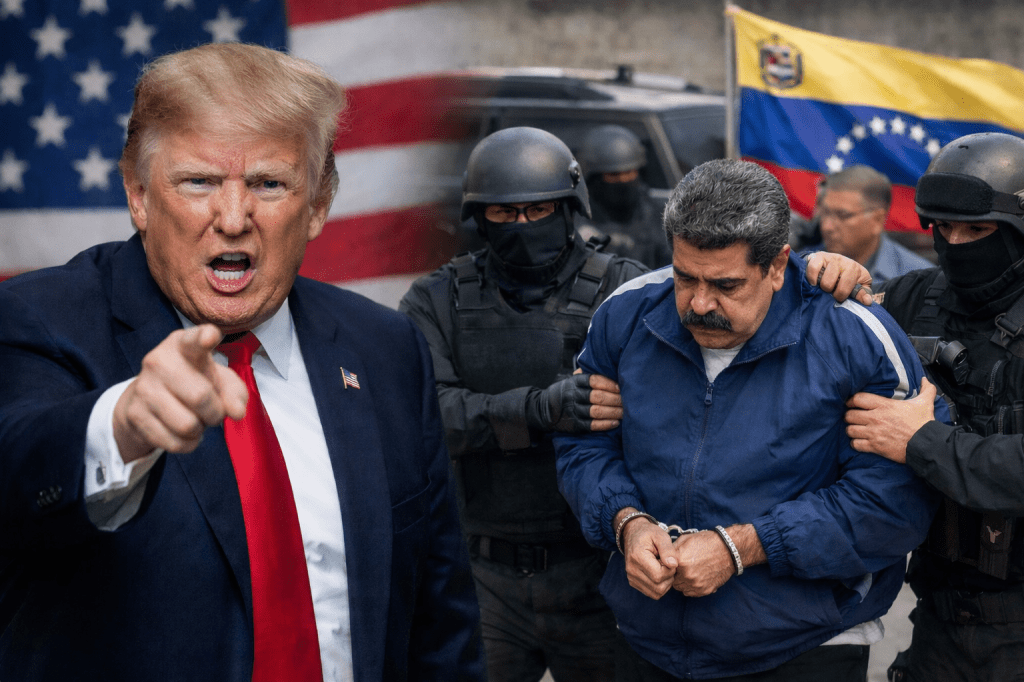
Donald Trump may have commanded headlines for ending eight wars in a single year, but the grim reality on the ground bears a haunting resemblance to Gaza—where over 200,000 innocent children perished while Trump heralded peace summits. Now, the dramatic arrest of Venezuelan President Nicolás Maduro by US forces has once again cleaved the world in two. Is this the restoration of democracy, or simply the imposition of will by holding a gun to the chest of a sovereign nation? Let us analyze every dimension of this watershed moment.
Why Did the Trump Government Kidnap the President of Venezuela?
For the US military to extract the president of another country from his very own palace is no ordinary geopolitical event. Both the official arguments given by America and the hidden economic reasons behind this are profound. Donald Trump’s government has named this action “Operation Absolute Resolve,” under which they have accused Nicolás Maduro of ‘Narco-Terrorism’—trafficking narcotics and terrorism. The US Department of Justice (DOJ) claims that Maduro’s government was running a criminal syndicate named the “Cartel of the Suns,” which is responsible for massive cocaine trafficking into the US. On this basis, a reward of millions of dollars was announced on his head back in 2020.
However, political analysts do not view this merely as an anti-drug campaign. The biggest reason behind this is the disputed Venezuelan elections of July 2024. In these elections, opposition candidate Edmundo González claimed victory and presented various evidences, but Nicolás Maduro declared himself the winner and maintained his grip on power. The US views this as the “theft of democracy.”
But behind the curtains, the real game is about “Oil.” Venezuela possesses the world’s largest proven oil reserves, which until now were within the sphere of influence of Russia and China. Under Trump’s “America First” policy, handing over these vast energy reserves to a pro-American government was a major economic priority, which is now being attempted by removing Maduro.
Venezuela’s Political History: Internal Strife and Foreign Interference
To understand Venezuela’s current tragedy, we must delve into the depths of its history, where the line between democracy and dictatorship has always been blurred. After the end of the dictatorship in 1958, the ‘Puntofijo Pact’ was signed, which laid the foundation for democracy but remained merely a power-sharing arrangement between two parties—the center-left ‘Democratic Action’ (AD) and the center-right ‘COPEI’. For decades, the country ran on oil revenues, but the crash in oil prices in the 1980s and the ‘Caracazo’ riots of 1989 exposed this system. There was massive public discontent, capitalizing on which Hugo Chávez came to power in 1998 and initiated the “Bolivarian Revolution.”
Hugo Chávez completely transformed the country’s politics. He formed the ‘United Socialist Party of Venezuela’ (PSUV) and began funneling oil revenues into housing and health schemes for the poor. This made him a messiah for the poor, but the wealthy class and America became his staunch enemies. This is where open foreign interference began. In 2002, a coup attempt against Chávez, allegedly supported by the US, took place but failed. After Chávez’s death in 2013, Nicolás Maduro took over. Maduro possessed neither Chávez’s charisma nor high oil prices. Under his government, corruption increased, and the economy hit rock bottom, giving the opposition a new lease on life.
The turning point in Venezuelan politics came when the opposition coalition (MUD) won the 2015 parliamentary elections. Seeing his defeat, Maduro used the Supreme Court to strip the parliament of its powers and formed a parallel ‘Constituent Assembly.’ From here, Venezuela moved toward full dictatorship. In 2019, the US recognized opposition leader Juan Guaidó as the interim president and imposed severe economic sanctions on Maduro, leaving the populace starving. Critics argue that the US deliberately broke Venezuela’s economy to weaken Maduro so that civil war-like conditions would arise, providing an opportunity for intervention. Russia and Cuba provided military and intelligence support to save Maduro, turning Venezuela into a Cold War arena.
Impact on the Future: What Precedent Has America Set for the World?
This move by the Trump administration sets a highly dangerous precedent for future global politics (Geopolitics). According to the United Nations (UN) Charter, entering a country’s borders to arrest its head of state is a direct attack on that country’s sovereignty. This incident has proven that international law is only for weak nations. This policy of “Might is Right” is now making small and resource-rich nations feel unsafe. This action is a direct message to countries like Iran, North Korea, and Nicaragua that if they go against US interests, their fate could be similar to Maduro’s.
The result of this will be a more unstable world. Countries will now accelerate the race for nuclear weapons for their security rather than relying on traditional diplomacy, as they will feel that only nuclear power can save them from a direct American invasion. Furthermore, if the method to bring “peace” and “democracy” becomes “invasion” and “kidnapping,” it goes against the very spirit of democracy. This incident will further widen the chasm between left-wing and right-wing ideologies in Latin America, increasing the risk of Proxy Wars in the future.
Reactions of World Leaders
The global reaction to this incident is extremely sharp and divided. Russian President Vladimir Putin and Chinese President Xi Jinping have termed it a “shredding of international law” and “daylight robbery.” They have warned that this step could ignite a major war in Latin America. Meanwhile, Latin American leftist leaders, such as Brazil’s President Lula and Colombia’s Gustavo Petro, are stunned by this event. They have called it the “brutal return of imperialism.” They fear that what happened to Venezuela today could happen to them tomorrow.
On the other hand, the European Union’s (EU) reaction is muted; they are happy with Maduro’s removal, but they are extremely uncomfortable with the “Method” the US used and consider it a dangerous precedent.
Donald Trump is calling this his “Great Victory,” but history bears witness that governments imposed from the outside often become the cause of prolonged civil wars. Just as peace did not come after removing Saddam Hussein in Iraq—rather, devastation followed—similarly, Maduro’s arrest in Venezuela might not be the end of its problems, but the beginning of a new, bloody chapter.
 The free voice