ISRO successfully launched its heaviest communication satellite, CMS-03, aboard the powerful LVM3-M5 ‘Bahubali’ rocket. Weighing 4,410 kg, the satellite will enhance communication services across India and surrounding oceanic regions. This marks LVM3’s fifth operational flight, following its Chandrayaan-3 mission.
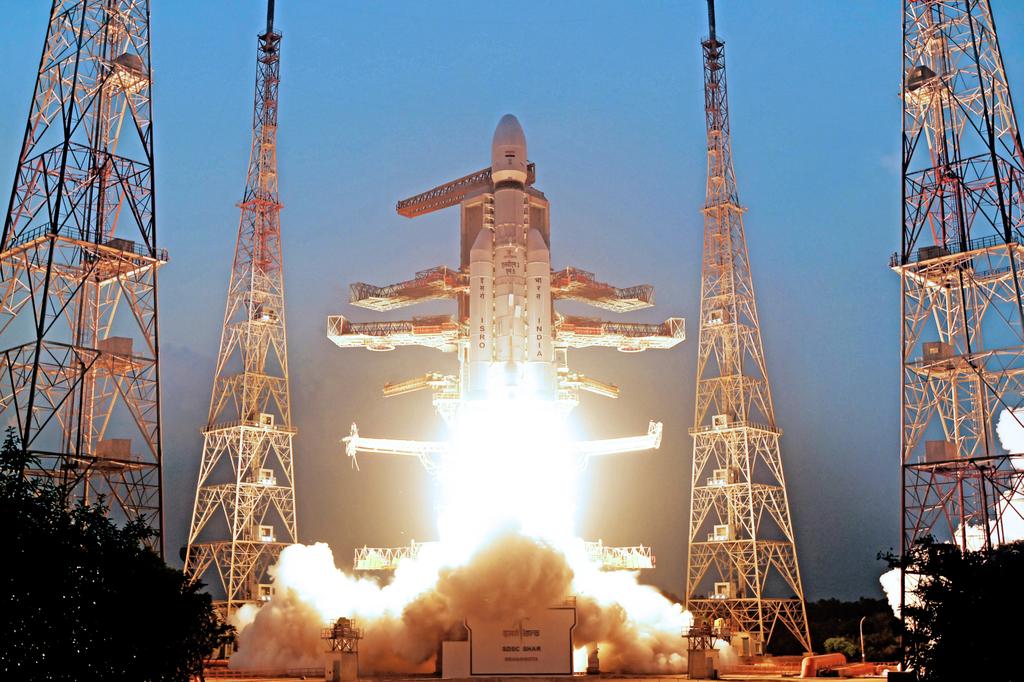
Indian Space Research Organisation (ISRO) successfully launched the country’s heaviest communication satellite, CMS-03, from the Satish Dhawan Space Centre in Sriharikota, Andhra Pradesh. The 4,410-kg satellite lifted off at 5:26 PM aboard the indigenously developed LVM3-M5 rocket, nicknamed ‘Bahubali’ for its massive lifting power. This was the rocket’s fifth operational mission, following the successful Chandrayaan-3 lunar mission in 2023.
A Powerful Launch for a Heavyweight Satellite
The LVM3-M5, a three-stage launch vehicle with solid, liquid, and cryogenic propulsion systems, flawlessly placed the CMS-03 satellite into its designated Geosynchronous Transfer Orbit (GTO). ISRO Chairman V. Narayanan confirmed the successful separation and orbital insertion, calling the mission “yet another moment of pride” for India’s space sector. He praised the team for overcoming challenging weather conditions and ensuring a smooth launch.
Dubbed ‘Bahubali’ for its strength, the LVM3 series has achieved a 100% success rate across eight missions, including experimental and operational launches. The rocket’s proven reliability has now made it India’s go-to vehicle for heavy payload missions, previously dependent on European Ariane rockets.
Advancing India’s Communication Network
CMS-03, a multi-band communication satellite, is designed to serve the Indian subcontinent and adjacent oceanic regions. It will play a crucial role in strengthening India’s communication infrastructure for civilian and strategic use. The satellite replaces the GSAT-7 series, launched in 2013, and is expected to operate for at least 15 years.
ISRO highlighted that the satellite would enhance connectivity under national programmes like Digital India and support secure communication for maritime and defence operations. The successful launch also signals India’s growing capability to independently handle heavy satellite missions, reducing reliance on foreign launchers.
Indigenous Power Behind ‘Bahubali’
The LVM3 vehicle represents a decade of indigenous innovation. Its cryogenic stage (C25) was developed entirely in India, a technological milestone that has made the country self-reliant in high-thrust rocket design. Earlier, ISRO had to depend on France-based Arianespace’s Ariane-5 rockets to launch heavy payloads such as GSAT-11 in 2018.
The success of LVM3-M5 has also boosted confidence ahead of India’s next big leap—the human spaceflight programme, Gaganyaan. ISRO confirmed that a human-rated version of the same rocket, HRLV, will carry Indian astronauts to space in the near future.
Prime Minister Narendra Modi congratulated ISRO scientists, saying the achievement “reaffirms India’s leadership in space technology and innovation.” Union Minister Jitendra Singh also praised the team for continuing India’s streak of space successes.
The CMS-03 mission not only cements India’s reputation as a rising space power but also showcases the country’s ability to develop, build, and launch complex satellites entirely with homegrown expertise. With this successful flight, ISRO has once again proven that India’s journey to the stars is firmly powered by its own strength.
 The free voice