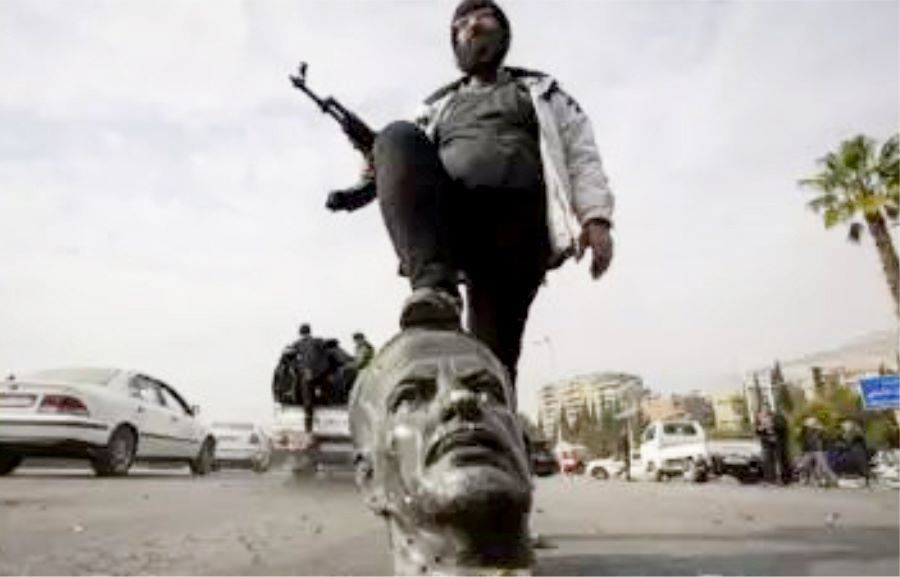
The Assad family’s five-decade-long grip on power in Syria has come to an end. Rebel factions, in a dramatic 11-day offensive, have seized control of major cities, including Aleppo, Homs, and now the capital, Damascus. According to Reuters, President Bashar al-Assad has fled Syria with his family and is reportedly in Moscow.
Amid this turmoil, Syrian Prime Minister Mohammad Ghazi Al Jalali released a video statement asserting his commitment to remain in Syria. He declared, “I am here and have no intention of leaving. I will ensure the smooth functioning of government and public institutions and safeguard the citizens of our nation.”
Opposition leader Ahmad Al-Bahra hailed the development as a turning point, stating, “The dark chapter of Syrian history has come to an end.”
Humanitarian Toll of the Conflict
The Syrian Observatory for Human Rights reports that the recent fighting has resulted in 800 deaths and displaced approximately 370,000 people. The capture of Damascus marks the most significant victory for the rebels in the 15-year civil war. Abu Mohammad al-Jolani, the leader of the rebel group Hayat Tahrir al-Sham, proclaimed, “We are now free.” In a symbolic gesture, rebels demolished the statue of Hafez al-Assad, the father of Bashar al-Assad, in Damascus
The U.S. Role in the Syrian Overthrow

The fall of the Assad regime has sparked speculation about the involvement of the United States. This development coincides with the final month of President Joe Biden’s term, with President-elect Donald Trump set to take office on January 20, 2025. Analysts suggest Biden’s actions might complicate Trump’s early tenure.
Recently, Biden authorized NATO allies to supply Ukraine with long-range missiles and essential equipment to counter Russia. Following the Israel-Hezbollah ceasefire, U.S.-backed Kurdish rebels and Hayat Tahrir al-Sham launched a coordinated offensive to capture Damascus. This has led to allegations that the U.S. facilitated the regime’s downfall through a carefully crafted strategy.
The geopolitical situation has also hindered Assad’s key allies. Iran, preoccupied with its conflict in Israel, has curtailed its support for Hezbollah, weakening their influence in Syria. Meanwhile, Russia, embroiled in its own war, was unable to provide substantial aid to the Assad regime.
Historical Context of Syria’s Civil War

Bashar al-Assad has ruled Syria since 2000, succeeding his father, Hafez al-Assad, who held power from 1971 to 2000. Following deteriorating relations with the U.S. in 2003, various rebel groups emerged to challenge Assad’s government. The peaceful protests of 2011 turned into a bloody civil war after government crackdowns, leading to the rise of multiple opposition factions.
In 2015, intense clashes between government forces and rebels resulted in insurgents controlling nearly 40% of Syrian territory. However, Assad managed to retain power with military support from Russia, Iran, Lebanon, and Hezbollah. Russia’s involvement, including deploying troops and fighter jets, was rewarded with long-term leases on strategic bases like Hmeimim Air Base and Tartus Naval Base.
The U.S. has also played a significant role. Under Barack Obama, the U.S. provided financial and military aid to Kurdish rebels, a policy partially scaled back during Trump’s administration but resumed after Biden’s election in 2020.
The civil war has claimed over 500,000 lives and displaced 16 million people, according to the Syrian Observatory for Human Rights.
The Fall of Damascus: Impact on Regional Players
Israel has also reacted to the developments. Israeli Prime Minister Benjamin Netanyahu stated in a video message that the Golan Heights agreement with the Syrian government is now void. Israeli forces reportedly moved 10 kilometers into Syrian territory near the Golan Heights, emphasizing the uncertainty in the region following Assad’s departure.
Repercussions for India
Syria’s transition marks the beginning of a new era, but the road ahead remains fraught with challenges. The humanitarian crisis, geopolitical ramifications, and the redefinition of regional alliances will shape Syria’s future and its role on the global stage.
The collapse of the Assad regime poses significant challenges for India. Syria has been a key partner in cultural and trade relations. India extended a $240 million loan for rebuilding the Tishreen Thermal Power Plant and had plans for substantial investments in the India-Middle East-Europe Economic Corridor, which included Syria.
Furthermore, India’s ONGC Videsh and China’s CNPC jointly hold a 37% stake in Syria’s Canadian oil fields. With the political upheaval, these investments face an uncertain future.
From a strategic perspective, Syria has held significant importance for India. This is because Syria has consistently supported India on the Kashmir issue at the United Nations and other international forums. In return, India has also supported Syria on the issue of the Golan Heights, one of the disputed territories between Syria and Israel.
The Golan Heights remains a key area of contention in the Middle East, symbolizing broader regional tensions. Following the fall of the Assad government in Syria, there is now considerable anticipation regarding India’s next approach toward the evolving situation in Syria.
This relationship highlights the intricate balance of international diplomacy and mutual support, which has defined India’s engagement with Syria over the years.
 The free voice